Starter walkthrough
How to Play Relic Putt
Two decisions per hole: where the ball lands, and when the relic fires.
Relic Putt is a browser mini golf game, and its rule set is short enough to learn in one hole. You drag back to swing, release to send the ball, and then choose a moment in mid-air to use the relic you picked after the previous hole. Everything else is course reading.
The swing in three steps
Press on the ball, drag backwards, and watch the power indicator. The drag distance is your entire aim and your entire strength at once, so a long pull is a long shot and a short pull is a tap. Let go and the shot commits — there is no undo, no follow-through to adjust, and no second chance to soften it.
The third step is the one people skip: watch the landing. Not the flag, the landing. Note whether the ball stopped short, rolled past, or drifted sideways, then correct that one thing on the next shot instead of rebuilding the whole stroke from scratch and losing the feeling you just paid for.
Repeat that loop five times and you have played a hole. A repeatable pull-back distance is worth more than any single clever line, because every relic decision afterwards gets measured against it — and if you do not know how far your own swing goes, you cannot tell what the relic changed.
Firing a relic mid-air
Press Space, or tap the screen, while the ball is still flying. The relic in your slot activates at that moment and changes what the ball does next. That is the whole input — there is nothing to aim and nothing to confirm.
The constraint is the window. Once the ball comes to rest, the chance is gone until the next shot, so you are choosing a moment inside the flight, not after it. Early in a shot the relic tends to act on a ball with more travel left; late in a shot it acts on a ball almost done. Use that difference deliberately.
If the press seems to do nothing, check two things: whether the ball is still in the air, and whether a relic is actually equipped. Pressing while the screen is between shots is the most common cause, because the game gives no error — the window simply is not open yet, so wait for the next flight and try again.
How many shots you get, and where the par changes
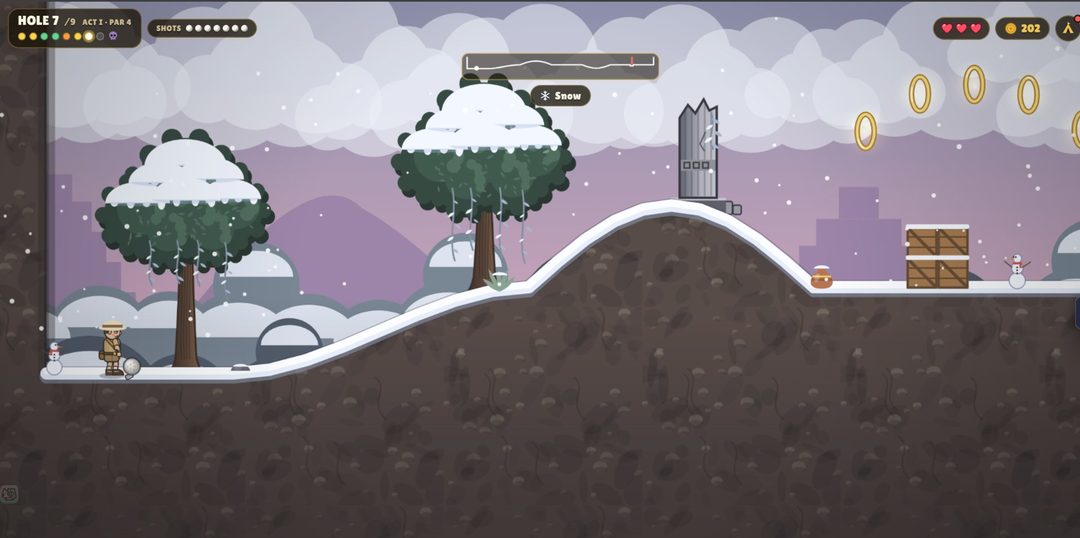
Holes are grouped into acts, and each act holds nine holes. The par is not the same all the way through: the early holes in an act are par-3, and later on the course starts setting par-4 holes. You can see which one you are on before you swing, because the HUD names the hole and its par together in the top-left corner.
On a par-3 hole the game gives you six shots, so treat that as your working budget. Six is double the par, which leaves room for one ugly miss and one tidy recovery without the hole turning into a write-off. Spend the first shots reading the hole and the later ones solving it, rather than trying to solve it with the very first swing.
Read the par first, then plan. A par-4 hole asks for an extra shot of travel, so the split that works on a par-3 — place the ball, work toward the hole, keep the rest as insurance — has one more station in it. Planning three shots on a hole that wants four is how a comfortable budget turns into a scramble.
A practical split on a par-3: use shot one to place the ball somewhere you can see the next line from, shots two and three to work toward the hole, and keep the rest as insurance. When a hole puts water or spikes in play, giving up a shot to stay dry is almost always cheaper than a retry.
The opposite instinct — trying to hole out in one heroic stroke — is what eats the budget. On a par-3 you have six shots, not one, so the structure rewards patience far more than luck, and the hole where your safe line looks dull is usually the hole that ends with shots to spare.
Choosing one of three relics
The choice happens after you finish a hole, not before you start one. Three options appear, you pick one, and it becomes your active relic for the following hole. So the decision is always forward-looking, aimed at a hole you have not seen yet, which is why your most recent mistake is better evidence than your imagination.
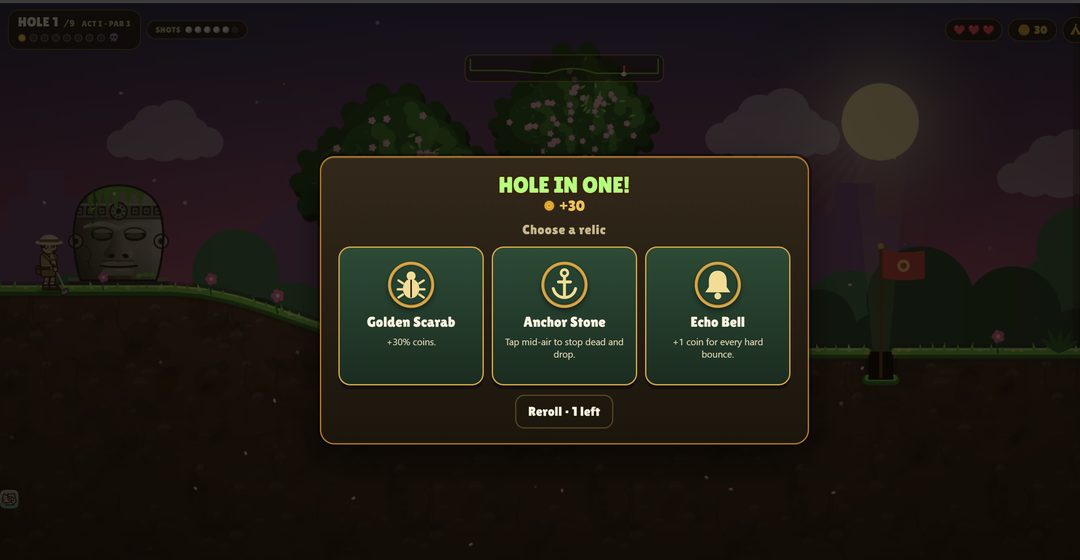
Read the description under each name rather than the name itself, and pick the one that answers the problem you just had. If the last hole punished a ball that ran long, take the option that relates to how the ball travels and stop guessing from the label alone.
The full relic list quotes each card verbatim and pairs it with a reading method, if you want both before your next round. The habit that matters: take one relic across a couple of holes and actually watch what changes. Taking a new relic every hole while also changing your aim means nothing is ever isolated, and you leave the session with no idea which part of the setup worked — only a vague feeling that some shots went better than others.
A reroll button sits under the three cards with a limited count beside it, so a weak spread costs you a reroll rather than a wasted hole.
Spend it when all three miss the problem you just had, and hold it when one card is merely unexciting but fits. Card text for every relic we have seen is quoted word for word in our relic list.
The HUD tells you most of it before you swing
Everything the game wants you to know before a shot sits in a thin strip along the top, and reading it takes about a second. It is the cheapest habit on this page, and the one most players skip, because the course in front of them is more interesting than a row of small numbers.
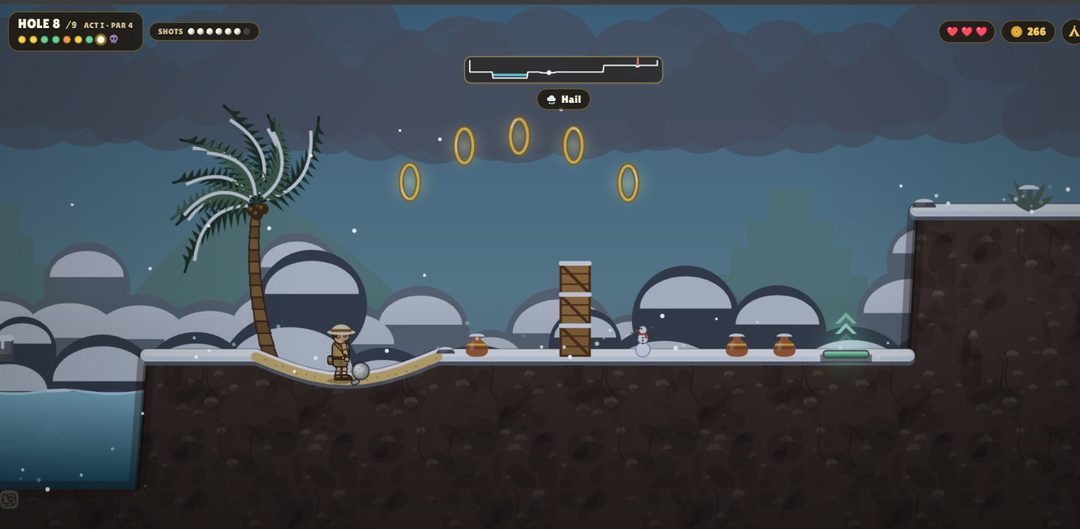
The hole counter is also the honest measure of progress. It reads as hole out of nine inside an act — an act being the game's own grouping, nine holes long — so a session has a visible shape rather than being an endless set of greens, useful if you are deciding whether to start one more hole.
Five mistakes most first rounds share
- Changing several things at once A new pull-back length plus a new relic plus a new line tells you nothing about any of them. Change one and keep the rest fixed.
- Staring at the flag Aim at a landing spot you can actually see, then work from there. The flag is the destination, not the target of the first shot.
- Ignoring the weather The course changes weather, and a shot that worked under one sky will not behave the same under the next. Look up before you pull back.
- Hammering the relic key Pressing repeatedly does not stack effects — you get one activation per flight. Time it instead of mashing it.
- Immediate retries without reading the miss Reswinging instantly throws away the one piece of evidence you just paid a shot for. Look at the resting spot first.
Try one hole with the rules in hand
Before you go further, open the player below and run a single hole with those five mistakes in mind. Pull back to a length you can repeat rather than a length you hope works, release, then press Space once while the ball is travelling and watch what it does. One clean hole lines up everything above faster than rereading it.
What to read next
If you already understand the loop and only want the inputs, the keyboard, mouse and touch control reference is one table long. If the loop makes sense but your scores are stuck, the tips for planning the landing cover the habits that separate a tidy round from a scrappy one.
Either way, give the game one clean round first. The written part is much easier to apply once your hands already know what a pull-back feels like, and the two pages make far more sense after you have lost a hole to a shot you could have avoided. Nine golfers also unlock as you keep playing, but none of them changes the loop on this page.
Six shots on a par-3, one relic in your pocket. That is the entire game — now go spend them.